Thursday, May 22, 2014

A Tour of Bakersfield's Bungalow Courts

EDITED 9/2/2014 with new information.

Bungalow courts started being built just prior to World War I, and from 1910 to 1930, they were the dominant multi-family dwelling type in Southern California. Pasadena holds the distinction of having the first bungalow court. It was designed in 1909 by Sylvanus Marston who placed eleven full-sized bungalow houses in a courtyard arrangement. The earliest bungalow court that I could find in Bakersfield is the court at 926 Lake Street in East Bakersfield. It was built in 1910 by Contractor Young of Santa Barbara for Mathias Warren (Earl Warren's father) as rental units. As the 1912 Sanborn Fire Insurance Map of Bakersfield shows, the court originally had six units with a walkway leading off of Lake Street. Four units survive.

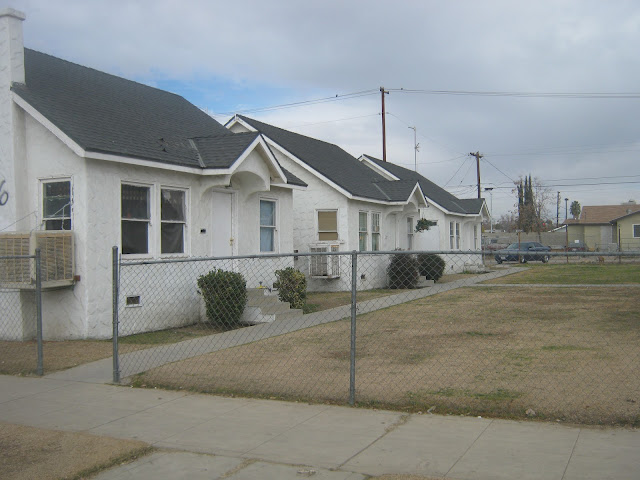
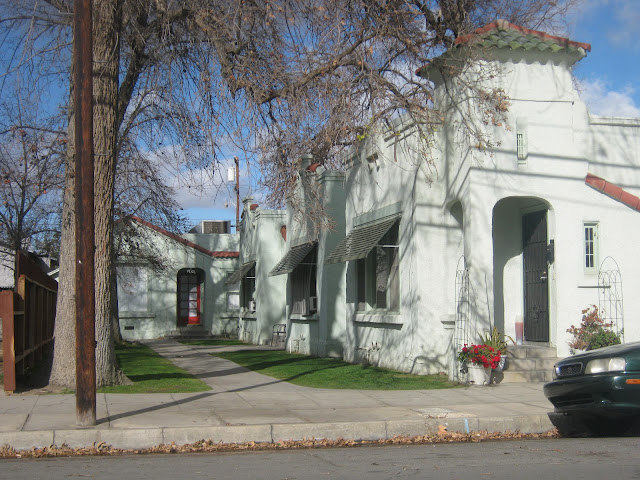
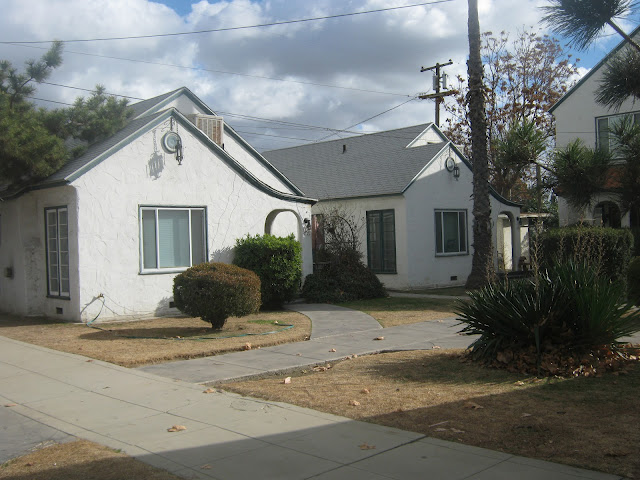
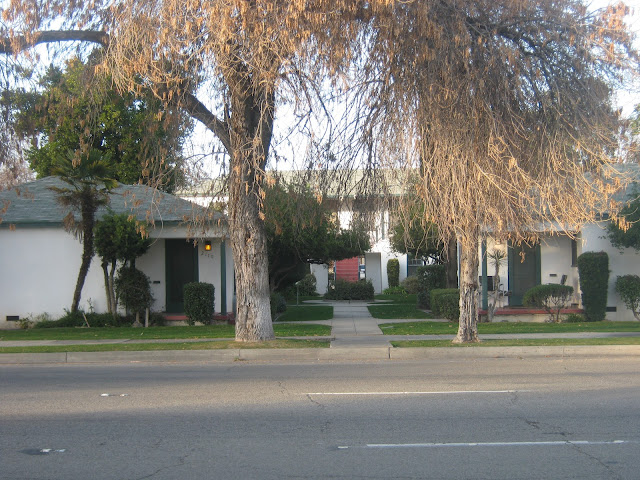
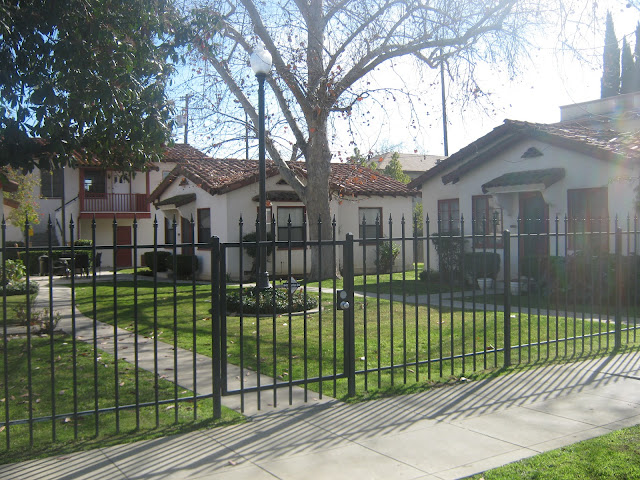
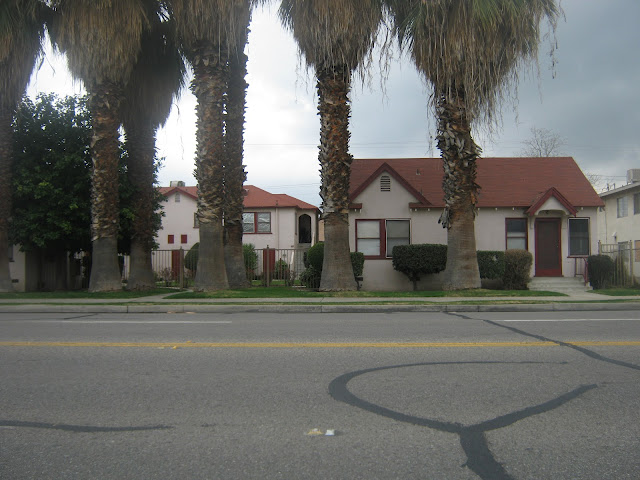
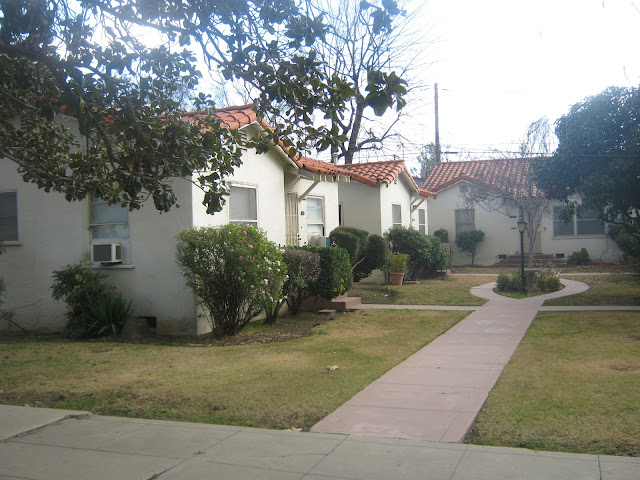
A typical bungalow court consists of six to ten small, individual houses placed around a communal green space. Each house usually consists of only one bedroom. Most bungalow courts are kept to two standard city lots, and parking is usually limited and is often at the rear of the units, in the alleyway, or on the street.  906 Kentucky Street, with its three bungalows on either side of a central lawn, is an example of a typical bungalow court arrangement. Bungalow courts can also be found in other, less common arrangements. Paynter Court (1717 Palm Street) is an example of a U–shaped court, which is characterized by a duplex or, in this case, a small apartment house at the back. Individual cottages or even a series of duplexes or triplexes arranged around a long, narrow, garden-like walkway can also be considered a bungalow court.  St. Elmo Court is an example of an attached, narrow court in which a common walkway and yard is shared by four, attached, residences.

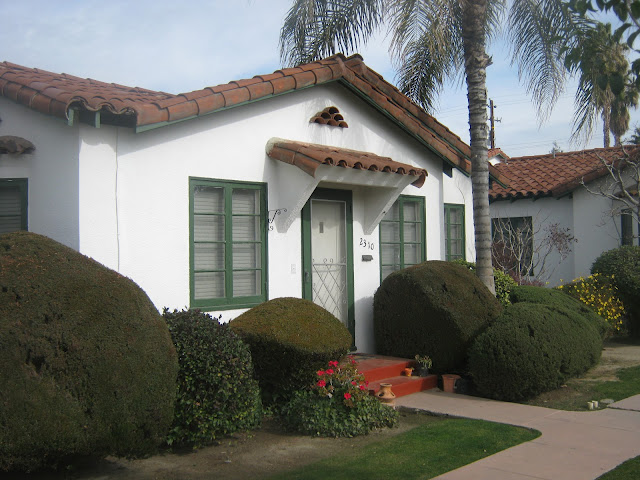
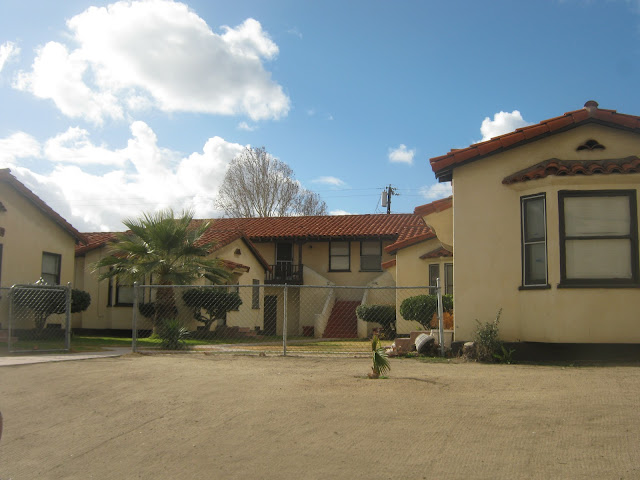
What separates a bungalow court from other detached multiple housing units that were built later has to do with aesthetic. From distinctive tilework (St. Elmo Court) to Spanish tile roofs (2001 Blanche Street) to bay windows (El Maiz Court, 101 Eye Street) to exposed beams (Ye Olde English Village Court Apartments, 1823 Myrtle Street), bungalow courts have a quaintness and approachability missing from more tenement-like apartment complexes.

Bungalow courts were built throughout Bakersfield. Many are tucked into residential neighborhoods that were being developed on former farmland. For example, the bungalow courts near 23rd and D streets (Finlayson, Spreyer, and Swanson courts) were built on former Kern County Land Company land. When they were built in the late 1930s, the land was at the northern edge of town.  Bungalow courts were also built on land that was being subdivided from larger properties; 1717 Baker was built next to dentist’s G. L. Brown’s house on land that had been part of Dr. Brown’s orchard.

During the bungalow court’s heyday, American society was drastically changing as large numbers of young people sought opportunities away from their families. This included young men returning from the military as well as young women entering the workforce. Traditional housing types - mainly single family homes, boarding houses, and city apartments - did not meet the new demand. Courtyard housing provided a sense of community as well as independence.

Media endorsed bungalow court living for young women. In 1913, an article in Ladies' Home Journal concluded that “very few persons, particularly women, can be happy outside of a pleasant home. An apartment in a great boxlike building is frequently the solution, as a house to one's self is apt to be not only lonely, but expensive as well. In California, the court apartment has solved the problem in a practical and economical way.” Women may have been the primary residents of bungalow courts in Southern California, but this does not seem to have been the case in Bakersfield. Only about 20% of the heads of households living in a bungalow court apartment as listed in the 1930 Bakersfield City Directory were women. Considering that Bakersfield’s main industries were oil and agriculture – both male-dominated fields – it seems reasonable that most of the bungalow court residents were male. Many young couples also lived in the units, but pets and children were not allowed.

After World War II, bungalow courts fell out of favor as emphasis was placed on building single-family homes in newly developing suburbs. The 1960s saw the development of large-scale apartment buildings that allowed for much higher housing density. While groupings of one-story units continued to be built in Bakersfield, these groupings lack the personality, beauty, and approachability that was prevalent in the earlier courts.

A few of Bakersfield’s Bungalow Courts:

  • 926 Lake Street
    Built: 1910
    (picture coming soon)
  • St. Elmo Court
    1800 Forrest Street
    Built: circa 1919

  • Imperial Court
    1302 M Street
    Built: 1923
  • Alta Vista Court
    110 Kentucky Street
    Built: 1925
  • Los Olivas Court
    1022 Truxtun Avenue
    Built: 1926
    “TO SUB-LET until September 1 bungalow, in bungalow court. Electric fan, Victrola and records, silver and linen and telephone. Front rooms and bath. Call 2880-R, or come to 1022 Truxtun avenue.” The Bakersfield Californian, 6/14/1927
  • 2016-2030 C Street
    Built: 1928

  • 311 East 19th Street
    Built: 1928

  • De Luxe Court
    509 B Street
    Built: 1929
  • 1717 Baker Street
    Built: 1929
    “Seven-unit bungalow court to cost $20,000. Handsome Improvement to Be Constructed on Baker Street 1700 Block.”The Bakersfield Californian, 4/6/1929

  • 906 Kentucky
    Built: 1929

  • Ye Olde English Village Court Apartments
    1823 Myrtle Street
    Built: 1929
    Architects: Ernest J. Kump Jr. and Ernest J. Kump Sr.

  • 1906 Forrest Street
    Built: circa 1930

  • Paynter Court
    1717 Palm Street
    Built: 1931

  • Finlayson Court
    2100 23rd Street
    Built: 1937
    “REAL ESTATE NEWS BRIEFS Finlayson Court Foundations have been laid and workmen are busy with the upper structure of the new six-unit Monterey court to be erected at the corner of Twenty-third and D streets by Mr. and Mrs. Frank Finlayson.”
    The Bakersfield Californian, 1/23/1937

  • Spreyer Court (also called Dolores Court)
    2210 D Street
    Built: 1937

  • Swanson Court (also called El Encanto Court)
    2300 D Street
    Built: 1937

  • 520 H Street
    Built: circa 1937

  • Westwind Court
    705 K Street
    Built: 1937
  • 1714 Quincy
    Built: circa 1938
  • 2001 Blanche Street
    Built: 1938
    “FOR RENT - New modern bungalow courts, near high school, completely furnished $50, partly furnished $42.50. Inquire 2001 Blanche street or call 3034-J in afternoon.” The Bakersfield Californian, 2/24/1938

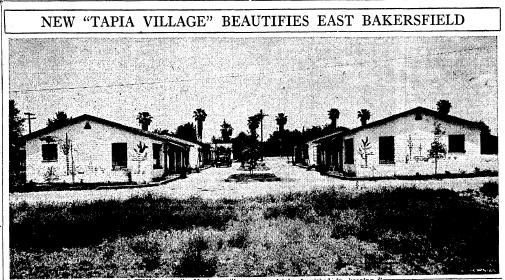
  • Tapia Village
    1819 Niles Street and 1802 Monterey
    Built: 1938
    Original Owner: F. M. Franklin

  • El Maiz Court
    101 Eye Street
    Built: 1940
    Builder J. M. Corn chose the Spanish translation of his surname when naming his bungalow court.


1910 Bakersfield City Directory

I've transcribed the 1910 Bakersfield City Directory! Please click on the link to take you to the directory - 1910 Bakersfield City Directory.

Disclaimer - There may be some mistakes. I suggest double checking the source. The Beale Library has the city directory as does the Kern County Museum.

Saturday, September 14, 2013

1899 Bakersfield City Directory

Here's a link the 1899 Bakersfield Directory in excel format!

Disclaimer - There may be some mistakes. I suggest going to the original source to verify all information. The Beale Library has the directory as does the Kern County Museum.

Wednesday, September 11, 2013

The Midnight Battle at Midway


                Kern County’s petroleum history isn’t all gushers and boom towns. There is also a much darker side to the history that includes claim jumpers, vigilantes, attempted murder, and suicide. One of the darker incidents occurred in 1901 when two rival oil companies clashed over land in the Midway oilfield near Taft. Many of Bakersfield’s respected and upstanding men were involved in what became known as the Midnight Battle at Midway that left two men were critically wounded.

Oil was discovered to be profitable in the late 1890s in Kern County. By the turn of the century, legions of potential oil men flocked to Kern County to speculate, stake claims, and try to make a dollar. Oil companies sprang up overnight and many ceased to exist the next day. The initial focus in the area was on the Kern River field due to its close proximity to Bakersfield and the rail line, but with improved transportation and as want for oil increased, focus was turned to the west side of Kern County including the Midway field. The Midway field is a tract of land about half-way between the Sunset and McKittrick oilfields. On January 31, 1901, The Los Angeles Herald noted the emerging importance of the field: “Midway between the McKittrick and the Sunset districts is a field to which little attention has been given by oil men owing to the distance from transportation and because other larger things seemed easier to grasp; but some day oil men may be fighting for land here and paying fancy prices for it. That some one has faith in the land lying between the two points named as an oil proposition is shown by the fact that there is now hardly a quarter section of land on the line that does not have a derrick on it or a claim notice posted. There are no less than sixty derricks along the line which have been built to show somebody’s good intentions.”

Oil was a new business venture at the turn of the century, and the laws governing the oil lands were lacking and confusing. As a public land state, most of California’s land was held in public trust. To obtain public land – whether to own or just to use – one had to either apply either under the laws providing for mining use or the laws providing for the disposal of agricultural lands. Until the fall of 1908 when the lands thought to be valuable for petroleum were withdrawn from agricultural entry, it was possible for two people to claim drilling rights to the same section of land – one under mining law and one under agricultural law. Understandably, this led to numerous conflicts. Additionally, applying mining law to oil lands caused its own problems. The mining law required that there be an actual discovery of the intended mineral before the patent could be granted. This requirement made it necessary for oil speculators to drill upon the land to which they had no legal title, and, in many places, rival claimants were drilling upon the same tract of land to see who could first obtain oil and thus get the title to the land. Naturally, this too led to numerous conflicts. One such conflict started in April 1901 and didn’t end until many years later.

                In the early spring of 1901, the Mount Diablo Mining & Development Company obtained land from locators for $15 an acre on section 26 in the Midway field. They then filed an agricultural claim and completed about $1200 worth of assessment work. The Mount Diablo Company was owned by Joseph Anderson Chanslor, one of the most prominent oil speculators and real estate brokers of the time in California.  He had dealings with Edward Doheny, and also worked with Charles Canfield in developing the Coalinga oil fields. Chanslor was known as “the boy millionaire of the oil fields” due to his boyish appearance and his success in the oilfields.

Finding the land empty, on April 14, the newly formed Superior Sunset Oil Company moved onto the northwest corner of section 26 with the intent of filing a mining claim once oil was discovered. They built a bunkhouse and cookhouse as well as started constructing a derrick.  Associated with the company were: president Jesse W. Crosland, owner of Bakersfield Hardware Company; director Will S. Kimball, a Bakersfield drug clerk; director George Haberfelde, a sewing machine agent; stockholder Charles L. Claflin, a Kern County lawyer and former Superior Court judge of Modoc county; investor J. T. Walker, a former sheriff and county supervisor in Nevada. Employed by the company were: George P. Cornell Jr., twenty-five-year-old son of a prominent Plumas County gold miner; Tom Briggs, a carpenter; F. M. Barling; and a Chinese cook.

The Mt. Diablo company later claimed that they had a man stationed on the property when the Superior Sunset people “jumped” it. Superior Sunset conceded that Samuel J. Dunlop, the original founder of the Mt. Diablo company, had told them that the land belonged to Mt. Diablo but argued that there was no one on the land when they took possession.  Disregarding the information provided by Dunlop or perhaps just acting on the belief that the land was available and the Mt. Diablo people were simply trying to intimidate, the Superior Sunset company continued to occupy the land.

The Mt. Diablo and Superior Sunset people could have tried to work out the dispute in court, but legal action probably would have taken months if not years. At least one member of the Mt. Diablo company – Bakersfield physician Augustus F. Schafer - had much of his savings tied up in the Mt. Diablo company and couldn’t afford to lose his investment. Speaking to Mrs. Crosland, Dr. Schafer threatened to “kill every body on the place and destroy the property to get the land back.” Wanting the matter resolved as soon as possible, the Mt. Diablo people decided to take matters into their own hands. On April 18, The Los Angeles Herald reported: “The Mt. Diablo people claim that their land has been jumped without cause. While doing but little talking, the promoters of the Mt. Diablo company intimate that a force of men might be useful in regaining possession of the land.”

On April 19, 1901, approximately 20 officers, directors, and stockholders of the Mt. Diablo company formed a vigilante group and set out towards the contested land. The men later identified as being involved were: Joseph A. Chanslor; Dr. A. F. Schafer; Ellsworth John Boust, a former deputy US Marshal; J. W. Jameson, a Bakersfield attorney; Dunlop, first president of the Mount Diablo Oil Company before selling to Chanslor; H. C. Fertig, manager of the Union Hardware & Metal Company in Bakersfield; Horace P. Anderson, an associate of Chanslor’s father in the grocery business; Milt Donley and his brother John Donley; Wilburn A. Hendryx,; George L. Berger; Charles Todd; C. A. Neal (or Neil); J. T. Chick; Charles Hall; John F. Wootan of Selma; Fred Price; and Frederick E. Mannel.

Armed with repeating rifles, shotguns, and pistols, the vigilantes snuck up on the sleeping Superior Sunset camp at about 12:30am. That night’s new moon rendered the desolate area nearly pitch black, and those who witnessed the party’s travel through the area noted that the men wore their hats low and their collar brims up, thus making it even more difficult to identify them. Dr. Schafer later claimed that the only reason they arrived so late was that they got lost on their way to camp.  The vigilantes approached in a semi-circular line and stopped upon reaching a small rise overlooking the camp – about 60 yards from the bunkhouse and 150 yards from the derrick.  

Sleeping outside, Cornell was the first of the Superior Sunset company the vigilantes encountered. Crosland, Haberfelde, the Chinese cook, and blacksmith and horseshoer “Doc” Starns (who conducted a teaming business in the oil districts and happened to bunk at the camp that night) were sleeping in the bunkhouse.  Walker was sleeping at the derrick. Barling slept in a tent, and it is unclear where Briggs was sleeping.   

Hearing the approach of the party, Cornell hollered for them to stop. One of the vigilantes informed Cornell that they were vigilantes come to take back the land and then instructed Cornell to surrender and put his hands up. When Cornell defiantly refused and told them to put their own hands up, one of the vigilantes said, “kill him, boys,” and the vigilantes opened fire. Cornell attempted  to take cover behind the water tank as the vigilantes fired two volleys. Woken by the first volley and perhaps acting on the instinct of a former sheriff, Walker rushed toward the bunkhouse. The other Superior Sunset men either hid near where they had been sleeping or took cover in the darkness of the desert.

When the vigilantes eventually stopped shooting, they yelled a warning to the hiding Superior Sunset men that they would be back if Superior Sunset did not vacate the land. As the vigilantes retreated, Starns stepped out of the bunkhouse where he had been taking cover and found one vigilante still in the camp. The man threatened Starns, but Starns claimed to have no interest in the result of the contest. Perhaps recognizing Starns, the vigilante left without doing further harm.

Fifty-three shots were fired during the ambush - the water tank and bunkhouse were littered with bullets - but only two men were hit: Cornell and Walker. Cornell was found lying near the corner of the bunkhouse and Walker close to the cook wagon. Cornell had been shot twice - one of the shots shattered the bones in his left leg and the other entered his right chest and emerged near his spine. Walker was shot in the right side, above the waistband with the ball passing through the body and tearing out part of the spine. None of the vigilantes sustained any wounds and it is unclear if any of the Superior Sunset men even fired a shot although two bullet casings were later found near where Cornell had taken cover behind the water tank. Starns and Briggs carried the injured men into the bunkhouse to try to staunch their wounds.

At some point during the melee, Crosland had taken cover somewhere in the desert, and at about 2:00am, he came in out of the darkness and started for McKittrick to get a physician for the two injured men. It is unclear where Haberfelde was during or after the ambush. Crosland returned with Dr. W. P. Scott at about 10:00am, but in the meantime a Dr. Bentley had arrived from Sunset and dressed the wounds. Later that day, Walker and Cornell were moved to McKittrick to be attended by Dr. Scott. Both were expected to die, but, miraculously, both survived. They remained in McKittrick under a physician’s care for two months.  Cornell had to have his leg amputated and his right arm was permanently paralyzed.

The Superior Sunset Company did not immediately vacate the land, but on April 25, Mount Diablo and the Superior Sunset companies reached an agreement which resulted in the Superior Sunset company selling out to Mt. Diablo and going out of business.

At first none of the vigilantes admitted involvement in the ambush and a few outright denied having participated. Unfortunately, the Superior Sunset men could not identify most of the vigilantes, but Cornell was able to identify Boust based on Boust’s peculiar way of speaking. Boust denied being involved: A few days after the shooting, Boust visited Cornell on his presumed deathbed and was quoted in the San Francisco Call newspaper as saying, “I don’t like to call a dying man a liar, but you are very much mistaken.”  Dr. Schafer also denied being involved: “I have nothing to say concerning this shooting. I will deny, however, that I had a hand in it. Provided however, that I had been there, even alone I would tell openly in court that the man who was wounded was a hired assassin and I was sorry that the bullet didn’t kill him. However, as I was not there it is useless to talk of the matter.” In 1905 (after the statute of limitations had expired), both Boust and Schafer admitted that they were members of the vigilante party, a fact in which they seemed to have not a small amount of pride.

By June, warrants were issued for the arrest of the vigilantes on the charge of criminal conspiracy. The prosecution led by District Attorney Ahern and assisted by Attorney E. J. Emmons argued that a conspiracy was formed in the city to drive the alleged claim jumpers from the disputed land by force and with the intent to cause harm. The trial started in February 1902 before Justice of the Peace Millard. The case lingered for over a year and ended when Judge Millard dismissed the charges due to insufficient evidence. 

In March 1903, the Kern County Grand Jury took up the matter of the shooting. Feeling that the case had stalled, the Grand Jury requested Judge Millard to fix a date for the preliminary trial. In April 1903, the case was reopened and new charges were filed. This time the charge against the vigilantes was assault with deadly weapons.  The case once again lingered for a year. Fifteen of the accused were never arrested because they no longer lived in Kern County and little effort was made to find them. Warrants were sent to the Los Angeles sheriff for the arrests of Chanslor, Anderson, Hall, Berger, and Neil, but the Los Angeles sheriff reported back that their whereabouts were unknown.  Only Schafer, Boust and Price were arrested, but by April 1904, charges against the three men were dismissed once again due to insufficient evidence. Criminal proceedings came to an end on April 17, 1904 when the statute of limitations ran out and even the men who were never arrested could now walk free.

Not finding justice in criminal court, both Cornell and Walker attempted to sue the Mt. Diablo Company for damages received during the ambush. In June 1902, Walker sought $75,000 in damages - $50,000 for his injuries and $25,000 as punitive damages - from the Mt. Diablo Company. The trial finally started in February 1905, and on June 15, 1905, the court found that Walker,

“is, and was damaged by these defendants, Samuel J. Dunlap [sic], Milt Donley, A. F. Schaffer [sic], G. M. Donley, Geo. L. Berger, Chas. Todd, J. W. Jameson, C. A. Neil and Chas. Hall, in the sum of $5000, for the actual damages sustained, by reason of the pain and suffering and permanent injuries, wrongfully inflicted by the said defendants, and that the said plaintiff is entitled to, and does have, judgment against each and every one of said defendants, jointly and severally in the sum of $5000, together with interest thereon at the rate of 7 per cent from the date of same.”

An additional $3,500 was awarded as punitive damages. Unfortunately, Walker never saw any of the money. The defendants appealed the verdict, and in 1908, the California Supreme Court overturned the decision and ordered a new trial. Walker decided to not continue to pursue the case, and he faded from public record. In July 1903, Cornell also brought civil charges against the Mt. Diablo men, but presumably he was even unluckier than Walker for no mention was made in the newspapers about the result of the action.

Not finding recourse in either the criminal or civil courts, Cornell decided to seek revenge against two of his attackers. On the morning of April 16, 1904, as Schafer and Boust walked down Nineteenth Street in front of the Arlington Hotel, Cornell, with the assistance of his brother Lloyd, shot at Schafer and Boust. Both shots went wild and George Cornell was arrested. Crosland, Haberfelde, and Lloyd Cornell paid his bond. In June 1905, Cornell was tried for assault with a deadly weapon but was acquitted.

In 1910, the Mt. Diablo Company sold their property in the Midway field for $1,500,000, making the stockholders extremely wealthy. None of the vigilantes were found guilty of any crime associated with the battle at Midway, and most went on to be very successful. Chanslor continued to make a lot more money in the oil fields as an organizer in the Associated Oil Company, member of the firm of Chanslor-Canfield-Midway Oil Company, and a director of the Tidewater Associated Oil Company. He eventually retired to San Francisco and died in 1946 at the age of 78. Dr. Schafer became somewhat famous for creating a serum that he claimed could cure such diseases as typhoid, pneumonia, tuberculosis, and blood poisoning. He died of stomach cancer in 1926. Boust founded Boust City, a small hamlet near Taft known for its saloons, gambling dens, and brothels. Jameson continued investing in oil and helped found the city of Taft. Dunlop founded Dunlop Oil Company and became a Taft City Trustee. Anderson became the secretary for the Chanslor-Canfield-Midway Oil Company. Mannel later organized the Mannel-Minor Petroleum Company, which leased two hundred acres in the Belridge oilfield.

A few of the members of the Superior Sunset Company also found some amount of success: Crosland later entered into real estate and insurance in Bakersfield and died in 1935 at the age of 77; Haberfelde became a successful Ford automobile dealer in Bakersfield and died in 1962 at the age of 90. Kimball entered into a partnership with a Dr. Morrow to form Morrow-Kimball Drug Company, which later became Kimball-Stone Drug Company. He died in San Francisco at the age of 72. Claflin continued practicing law in Bakersfield with various law firms. Unfortunately, the two gunshot victims weren’t as lucky. Never recovering from the ordeal, George Cornell Jr. committed suicide in 1911 by shooting himself through the heart, and J. T. Walker’s fate is unknown.

 Much of Kern County’s oil history has been romanticized and celebrated, but no less important are the less than flattering stories of greed, intimidation, and attempted murder. The Midnight Battle at Midway shows that oilmen could be ruthless in their quest for black gold.

Monday, December 3, 2012

Early Bakersfield Gardens

Bakersfield at the turn of the nineteenth century was little more than a frontier town, but despite its roughness, Bakersfield residents were able to beautify their surroundings. Early Bakersfield residents altered their landscape in both large and small ways to fit their preconceived ideas of how cities, homes, and gardens should appear. In addition to channeling the Kern River and draining the swamp that was Bakersfield, residents also planted hedges, shade trees, flowers, and lawns and built arbors and laid sidewalks in an effort to shape their surroundings.

Bakersfield imported a variety of non-native plants – many of which are familiar to the modern gardener and a few that have lost favor except to heritage gardeners. Bakersfield residents often chose plants that fit their ideas of what a garden should contain. Many of their ideas were shaped by their experience with gardens on the East Coast as well as in Europe. While many yards had pansies, roses, and lawns reminiscent of east coast yards, residents also experimented with other plants. For example, William Tevis had a large bamboo grove at his Stockdale farm and many Bakersfield residents marveled at century plants in both public and private gardens.

For this brief study, I focused on the time period from 1888 when famed photographer Carleton Watkins came to the area to photograph ranches and homesteads to 1905 when Bakersfield started to experience somewhat of a population boom. The following list was gathered from Carleton Watkins’ 1888 photographs (and his wonderful descriptions of the gardens), letters and diaries of early residents, and newspaper articles and advertisements. This is not an exhaustive list of all the plants that were used by early residents, but could be used as a starting point for someone wanting to recreate an early Bakersfield garden. But, a word to the wise, this article is not an endorsement of any plants; some of the plants that early Bakersfield residents planted are invasive and, in my opinion, should not be planted.

Flowers
African Lily
California Violet (native)
Canna Lily
China Lily
Chrysanthemums
Four O'clocks (native)
Geranium
Hollyhock
Honeysuckle
Hyacinth
Jessamine
Morning Glory
Pansy
Petunia
Poppy (native)
Smilax
Stock
Sunflower
Tiger Lily
Verbena
Virginia Creeper
Wisteria

Roses
Banksia
Cherokee
Cloth of Gold
James Sprunt
Marchal Neil

Trees
Acacia
Almond
Apple
Apricot
Ash
Cedar
Cottonwood
Cypress
Date Palm
Elm
English Walnut
Eucalyptus
Fan Palm
Fig
Gum
Japanese Maple
Locust
Lombardy
Nectarine
Olive
Orange
Peach
Pear
Pines
Plum
Pomegranate
Poplar
Prune
Quince
Tulip
Umbrella
Willow

Thursday, November 29, 2012

A Little Shooting Bee with Dr. Lemke


Dr. Herman Lemke was living the proverbial American dream. Born in Berlin, Germany in 1864, Dr. Lemke “came from a very old and wealthy family and received a first class education.” He graduated from veterinary college at the age of 23, and after serving in the German army as a regimental veterinarian for a few years, he immigrated to the United States. He settled in Bakersfield in the early 1890s, and, after receiving his license to practice veterinary medicine from the State Veterinary Medical Board in 1893, he opened a practice on 18th Street near Chester Avenue.

In October of 1893, he married Maud Roberts, the eldest daughter of a prominent local farmer and former Confederate colonel, Elisha M. Roberts (for whom Roberts Lane in Bakersfield is named). The couple celebrated the arrival of their first daughter, Eda, the following year: “Dr. Lemke is the proud and happy father of a daughter. He is doing as well as could be expected under the circumstances that it is his first.” Another daughter, Gertrude, was born two years later. If Dr. Lemke’s standing in Bakersfield wasn’t secure in the community with his marriage to Maud, he cemented his prominence by hiring the architecture firm of B. McDougall and Sons to design his residence.  B. McDougall and Sons also designed the Southern Hotel, Kern County Hospital, and the Noriega and Olcese homes.

Dr. Lemke was also successful in his professional life. He maintained a thriving veterinary practice that advertised “Latest improved operating table. No danger,” was the deputy health officer for Kern County, and was on the board of the California State Veterinary Medical Association. This world crumbled and Dr. Lemke’s seemingly perfect life ended on the evening of April 16, 1896. While sitting down with his wife and daughter for supper, Lyons Brown, a former employee seeking restitution, shot Dr. Lemke twice. Dr. Lemke died at noon the following day.

Lyons Brown had worked for Dr. Lemke for about eight months but had been let go a few days prior to the shooting for insulting the Lemke’s housekeeper, Angelina Sellinger. At the time of his dismissal, Dr. Lemke owed him about $70, or two months’ worth of wages. Dr. Lemke informed him that he would have to wait to get his pay until Dr. Lemke was paid at the first of the month.  On the morning of the shooting, Brown went to the house and again demanded his payment. Relenting, Dr. Lemke told him that he would try to get the money and would meet him at the bank that afternoon. When Dr. Lemke went to the bank, Brown was not there. At about 7 o’clock that evening, Brown went to the house – first to the barn to retrieve some clothing that he had left behind and then he entered the house through the back door. Walking through the kitchen, he walked into the dining room. Mrs. Lemke sat with her side and back partly toward the door and was holding her daughter in her lap. Dr. Lemke sat across from her facing the doorway through which Brown had entered.

Brown again demanded payment from Dr. Lemke.  Upset at having his supper interrupted and his family disturbed, Dr. Lemke told Brown to leave and that he would talk to him after supper. According to Brown’s account, Dr. Lemke then pulled his pistol and threatened Brown. Both Dr. and Mrs. Lemke claim that Brown drew his pistol first. Regardless, Brown shot first. The first shot hit Dr. Lemke in the shoulder while he was still sitting down. Rising, the next shot struck him in the lower part of the right side of his chest. Brown’s next four shots went into the wall behind Dr. Lemke. With his revolver empty, Brown turned to run, and Dr. Lemke got off two shots with a bullet striking Brown in the left shoulder.

As Brown ran out of the house and towards downtown Bakersfield, he reloaded his revolver. Upon reaching the Arlington Hotel at 19th and Chester Avenue, Brown turned himself in to Deputy Canaday. Brown was taken to the County Hospital and held under guard.

In the meantime, the Drs. Rogers, Helm and Fegusson were called to attend to Dr. Lemke. It was determined that Dr. Lemke’s lung and possibly intestines and liver were pierced. An operation was conducted and a hypodermic injection was administered, but Dr. Lemke fell into a coma at 8am the following morning and died at noon.

Although Brown confessed to the killing, there were witnesses, and Brown had openly threatened to harm Dr. Lemke in the days previous to the shooting, the trial was not straight-forward. First, there was trouble sitting a jury; some potential jurors claimed to have a history with Dr. Lemke and others were prejudiced against Brown. Dr. Lemke was not as well liked by everyone in the community as his standing seemed to indicate. And there was also the question of Dr. Lemke’s pistol.

The trial began on June 12, 1896. The jury consisted of F. W. Snyder, J. B. Fisk, W. Canfield, F. C. Clark, Henry Pscherer, F. D. Foss, R. W. Gay, G. H. Deacon, J. M. Ruth, John O’Toole, R. M. Brown, and Charles Graves (who, incidentally, married Dr. Lemke’s widow in 1898). District Attorney Alvin Fay and by J. W. Mahon prosecuted the case.

The prosecution called Dr. Fergusson as the first witness and he testified to the wounds. W. R. Macmurdo was next to be called. He had surveyed the house and testified as to the location and range of the bullet holes.  Charles Maul, who sat on the Coroner’s Jury, was called to identify Dr. Lemke’s pistol. Brown had earlier stated that Dr. Lemke had pulled his pistol first but had difficulty cocking it. Maul showed that the pistol was in working order, although upon cross-examination the “cylinder never revolved at all.” Under-sheriff Pyle later testified for the defense that Dr. Lemke’s pistol did not work well when he examined it after the shooting. Angelina Sellinger and Mrs. Lemke were then next to testify.  Mrs. Sellinger testified as to the events leading up to the shooting: Brown stopping by the house in the morning and then again in the evening. She was not in the room when shooting occurred. Mrs. Lemke testified:

The doctor and myself and children were at the supper table. Brown came in from the kitchen and went around to the northeast side of the table. The doctor was sitting at the south end. When Brown came in he said to the doctor: “Have you been down town?”

“Yes sir,” replied the doctor.

“I did not see you.”

“May be you don’t think I was.”

“I don’t say so.”

“Go out of my house you ----- of -----.”

“I won’t do it. I have come for a settlement.”

“I tell you go. This is my family.”

“I know it.”

At this the doctor put his hands on the table, slightly pushing back his chair, and started to get up, and then Brown pulled his pistol and remarked: “You ----- of a -------, do you see this?”

“This is all I heard them say,” said the witness,  “and then the shooting began.”

 W. H. Scibner was the last to testify for the prosecution and he reported on his conversation with Dr. Lemke following the shooting: As soon as he heard the shooting, he and Mr. Cogdon ran over to the house and found Dr. Lemke lying on the sofa.  Dr. Lemke told him that “Brown had insulted the cook and they had had a shooting scrape.” According to Scribner’s testimony, Brown shot at Dr. Lemke three times and then Dr. Lemke fired twice. Missing him with the first shot, the second shot hit Brown in the shoulder.

Brown took the stand in his own defense. His version of the events placed Dr. Lemke as the aggressor:

“I told him I would go, and I hesitated, and he said ‘Are you not going,’ and then he began to stretch up and pull his pistol and said ‘By God I’ll settle you!’”

“He then tried to work his pistol. He was up by this time on his feet, and I called out: ‘Don’t shoot! Don’t shoot! If you don’t stop, ------- I’ll kill you!” I then pulled my gun and commenced to shoot.

 Defense attorneys Graham and Emmons called several witnesses to speak to the reputation of Dr. Lemke. Although it does not appear that anyone who knew Dr. Lemke testified, “ a number of [the witnesses] answered that [Dr. Lemke’s reputation] was bad, and they gave the names of citizens they had heard say so. Some of them had heard the same, but could not remember the names of those who had told them.”

Initially the jury was in a deadlock and asked to be discharged. The judge encouraged the jury to continue deliberating, and after an additional hour and a half of deliberation, they found Brown not guilty of killing Dr. Lemke. On leaving the court room one of the jurors was overheard telling Brown: “Be careful and don’t get into any more trouble like this.”

Leaving the courthouse, Brown boarded the train and headed to his home state of Kansas where the Tulare Register noted he will “likely find satisfaction after his arrival east in posing as a bad man from the wild west.” At least some Bakersfield residents weren’t happy with the outcome either: "It will scarcely be claimed by any one that the action of the jury in the case of Lyons Brown makes “life, liberty and the pursuit of happiness” in Kern county any safer than it has been in the past.”

But life went on. Dr. Lemke’s widow married one of the jurors, Charles Graves, and, after Mr. Graves died, she married Robert Davis. The Lemke’s youngest daughter Gertrude died at the age of twelve, and the eldest daughter married, had a family, and lived until the age of seventy-three. Lyons Brown’s whereabouts after leaving Bakersfield are a little more shrouded. According to an Ancestry.com search, there is a James Lyons Brown (1872-1938) who was born in Kansas and died in New Mexico and who married and had a family. Perhaps he took the juror's advice to heart.

Saturday, April 28, 2012

Bakersfield in Ashes: The Great Fire of 1889

As promised, here is my power point presentation from this morning's talk at the Beale Memorial Library - Bakersfield in Ashes: The Great Fire of 1889. I am still working out some kinks with the presentation as it appears online so I may be tweaking it in the next few days. Let me know if you have any ideas. Also, I do not own the rights to the images so I put a "X" across the images to protect me as well as you. Enjoy! Follow this link: Bakersfield in Ashes: The Great Fire of 1889